Family Tree Now Census Records Search Guide
Search U.S. census records for family history. Learn what 1790–1950 schedules contain, how to identify households and how to handle errors
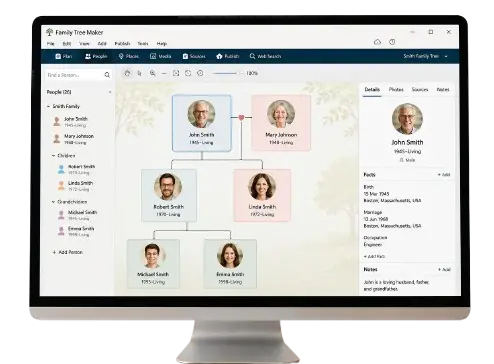
Census Records Search: Find Families Across Generations
A census captures a household at a particular moment. It can place parents and children under one roof, show where they were born and reveal occupations, immigration clues or changes in family structure. By following the same family from one census to the next, researchers can trace movement, marriages, deaths and children leaving home.
Census records are not perfect. Ages may be estimated, names misspelled and relationships misunderstood. The person answering the enumerator may not have supplied every detail. Used together with vital, church, land and probate records, however, censuses are among the strongest tools for Family Tree Now genealogy research.
U.S. Census Records at a Glance
The United States has conducted a federal population census every ten years since 1790. Personally identifiable schedules become public after 72 years. As of 2026, records from 1790 through 1950 are available for genealogical research. The 1960 schedules are scheduled for public release in April 2032.
The surviving information differs by year:
- 1790–1840: Generally names only the head of household and counts others by age and sex categories.
- 1850–1870: Lists each free household member by name, with age, sex, occupation, birthplace and other fields.
- 1880: Adds stated relationships to the head of household and parents’ birthplaces.
- 1890: Most general population schedules were destroyed; only fragments survive.
- 1900–1940: Often includes detailed birth, marriage, immigration, citizenship, occupation and housing information, with questions varying by year.
- 1950: Includes household relationships, ages, birthplaces, work information and additional sample questions for selected individuals.
Always check the blank form or question list for the year. A number in one column is meaningless unless you know the question asked.
Start With the Most Recent Available Census
The National Archives recommends working backward from the most recent public schedule. Begin with a household you can identify confidently and use its details to find the previous decade.
For a 1950 household, record:
- Names as enumerated
- Address
- Relationship to household head
- Age and marital status
- Birthplace
- Occupation or industry
- Other household members
- Neighbors
- Enumeration district and page
Then search 1940 using the adults’ names, ages, residence and relatives. Repeat the process, checking whether each decade fits the same family.
Build a Census Search Profile
Before opening an index, prepare:
- Full name and spelling variations
- Approximate birth year
- Birthplace
- Spouse and children
- Expected city, county and state
- Occupation
- Immigration year, if relevant
- Address from directories or records
Search a range of ages. A person reported as 35 in one census could appear as 42 or 46 ten years later.
Search Census Records by Name
If the first search fails:
- Remove the first name and search surname plus spouse.
- Use initials or nicknames.
- Search for a child with a less common name.
- Widen the birth-year range.
- Remove birthplace filters.
- Search the county rather than the town.
- Try phonetic surname spellings.
- Browse the enumeration district manually.
Indexing errors are common because handwriting is difficult and pages may be damaged. The family may be present even when the database cannot find the expected spelling.
Browse by Enumeration District
An enumeration district is the geographic area assigned to a census taker. If you know an address but cannot find a name, maps, directories and district tools can help you locate the correct set of pages.
Manual browsing is useful when:
- The surname is badly indexed
- The household lived at a known address
- A rural community has no precise street address
- You want to study neighbors
- The family appears at the page boundary
Read several pages before and after the household. Relatives and migration companions often lived nearby.
Understand Household Relationships
Relationship columns describe each person in relation to the designated head, not necessarily to everyone else.
“Daughter” means daughter of the head. A “grandson” could be the child of any son or daughter in the household. “Boarder,” “lodger,” “servant” or “partner” may describe an economic arrangement rather than the complete personal relationship.
Do not infer parentage without checking the household structure and other records. A niece could be a biological niece of the head or use a social title more loosely.
What Census Records Can Reveal
Birth and age
Censuses can estimate a birth year, but the value may shift. Use it as a range until a stronger source is found.
Marriage and family structure
Marital status and years married may guide a marriage search. Children’s ages can estimate when the household formed.
Migration
Birthplaces of parents and children can show movement. If older children were born in Pennsylvania and younger children in Ohio, the family likely moved between those births.
Immigration and citizenship
Some schedules ask arrival year, naturalization status or citizenship. Answers can vary, but they narrow searches for passenger and naturalization records.
Occupation and economic life
Occupation, industry and employment fields add context and can separate people with similar names.
Address and property
Street addresses, ownership and farm schedules can lead to deeds, maps and directories.
Special and Nonpopulation Schedules
Depending on the year and survival, separate schedules may cover agriculture, manufacturing, mortality, veterans or people receiving certain services. These can expand a basic household entry.
Mortality schedules generally list people who died during a defined period before the census. Agricultural schedules may describe land, livestock and production. Surviving 1890 veterans schedules can provide service information even though most population schedules are gone.
Check archive descriptions because coverage is incomplete and varies by state.
The 1890 Census Problem
Most 1890 U.S. general population schedules were destroyed after a 1921 fire and later disposal. A small number of fragments survive.
To bridge the 1880–1900 gap, use:
- State censuses
- City directories
- Voter registrations
- Tax and property records
- Marriage and death records
- Newspapers
- School and church registers
- Military and pension files
- Probate records
Do not treat the absence of an 1890 entry as evidence that a person moved or died.
State, Territorial and International Censuses
Some U.S. states conducted their own censuses between federal years. Territorial schedules can cover locations before statehood. Other countries used different schedules, intervals and privacy rules.
Study the collection before searching:
- What years survive?
- Who was counted?
- Is every person named?
- What geographic area is covered?
- Where are originals kept?
- Are images available or only an index?
A local census can place a family between federal schedules and clarify a move.
Evaluate Census Accuracy
Ask:
- Who likely answered the questions?
- Was the person home, or did a neighbor respond?
- Is the page clear?
- Did the indexer read the name correctly?
- Are relationships internally consistent?
- Does the household match other decades?
- Are ages plausible?
- Is there another family with the same names?
Transcribe what the schedule states before correcting or standardizing it in your tree.
Cite the Census Image
Include:
- Census year and jurisdiction
- County, township or city
- Enumeration district
- Sheet or page
- Dwelling and family numbers where present
- Person or household
- Archive or publication number
- Database and image number
- Access date
Save the entire page, not only a cropped name. The column headings and neighbors provide context.
Privacy and Restricted Censuses
Do not attempt to bypass the 72-year restriction. The Census Bureau offers an age-search service for a named person, heirs or legal representatives under specific conditions, but protected schedules are not open public genealogy databases.
Use aggregate modern census statistics without presenting them as individual household records.
Common Census Mistakes
- Treating ages as exact birth dates
- Assuming every household member is biologically related
- Ignoring neighbors
- Failing to view the original image
- Searching only one spelling
- Combining two same-name families
- Misreading residence as birthplace
- Forgetting boundary changes
- Assuming no 1890 result means the person disappeared
- Citing the index instead of the schedule
Frequently Asked Questions
What is the newest public U.S. census?
The 1950 census is the newest publicly available federal population schedule as of 2026. The 1960 census is due for release in 2032.
Are U.S. census records free?
The National Archives provides free access to the 1950 census and other resources. Commercial databases may charge, while many libraries provide access to subscriptions.
Why can I not find my relative?
The name may be misspelled or incorrectly indexed, the family may have moved, or the person may have been omitted. Search relatives and browse the district.
Can the census prove parentage?
It can provide relationship evidence, particularly from 1880 onward, but compare it with birth, marriage, church and probate records.
Why do ages change between censuses?
People guessed, informants differed, census dates changed and enumerators made errors. Use a range.
Where can I search official census records?
Start with the National Archives census research page and its catalog or partner access points.
Follow the Household Through Time
The power of census research comes from comparison. One schedule provides a snapshot; several schedules create a family timeline.
Continue with: