Family Tree Maker
Family Tree Maker | Build Your Ancestry Chart Online the world’s largest collection of online family history records makes it possible.
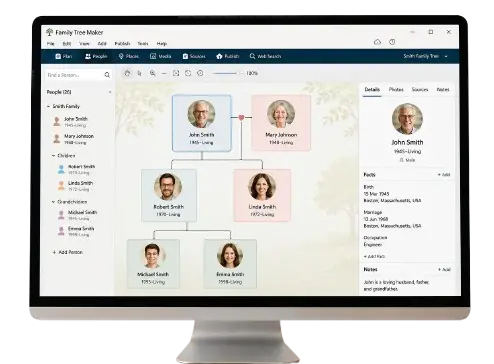
Family Tree Now: Build, Search and Preserve Your Family Story
Every family has a story. Some parts are remembered clearly. Others are hidden in old photographs, handwritten letters, certificates, newspaper notices and the memories of older relatives. Family Tree Now gives you a practical place to begin bringing those pieces together. Start with one person: yourself. Add your parents, grandparents, children, siblings and other relatives. Record the names, dates and places you already know. As your tree grows, you can identify missing information, plan your research and preserve important family details for the next generation. You do not need to be a professional genealogist. You do not need to know every date before you begin. Even a few names can become the starting point for a meaningful family history.Independent website notice: Family-TreeNow.com is an independent family-history resource. It is not affiliated with FamilyTreeNow.com, FamilySearch, Ancestry, MyHeritage, Family Tree Maker or any other genealogy company. References to third-party services are provided only for identification and educational purposes.
Begin Your Family Tree Now
Family history often feels complicated because the information is scattered. A birth date may be written inside a family Bible. A grandparent’s full name may appear on a marriage certificate. An old photograph may have a place written on the back, while a living relative remembers the story behind it. A family tree turns those separate details into an understandable structure. Begin with information that is close to you. Enter your name and then move outward to your parents and grandparents. Add siblings, spouses, children, aunts, uncles and cousins as you confirm each relationship. If a detail is uncertain, mark it as an estimate instead of presenting it as a verified fact. The purpose is not to complete your entire ancestry in one day. The goal is to create a reliable foundation that can grow over time.A simple starting tree might include:
- Your full name, including any previous or maiden name
- Your date and place of birth
- The names of your parents
- The names of your grandparents
- Marriage dates and locations
- Names of siblings, spouses and children
- Photographs, documents and family stories
- Notes showing where each important fact was found
What Is Family Tree Now?
Family Tree Now is a family-history starting point for people who want to organize relatives, understand relationships and research their ancestry more carefully. Some visitors arrive because they want to build a visual tree. Others are trying to identify an ancestor, locate a missing branch or learn how public records can support genealogical research. The Family Tree Now website brings these related goals together in one clear process: start with known relatives, search for supporting evidence and add only the information that can be reasonably verified. People may use the phrase “FamilyTreeNow” when looking for several different things:- A free family tree builder
- A genealogy or ancestor search
- A way to find relatives
- A people-search guide
- Historical public records
- Birth, marriage or death information
- Help organizing family photographs and stories
- A method for preserving research for children and grandchildren
Three Ways to Explore Your Family History
1. Build a Family Tree
A family tree is a visual map of relationships. It can show parents, children, siblings, spouses and extended relatives across several generations. Start with the people you know personally. Add one generation at a time and keep notes about uncertain facts. A smaller, accurate tree is more useful than a large tree filled with copied or unverified information.2. Search for Ancestors
Ancestor research usually involves historical documents. Census schedules, birth registrations, marriage records, death certificates, obituaries, military documents and immigration records may reveal details about earlier generations. A successful search normally requires more than a name. Approximate birth years, locations, occupations, spouse names and children’s names can help distinguish one person from another.3. Research Living Relatives Responsibly
A Family Tree Now relatives search may involve living people as well as deceased ancestors. When researching living relatives, privacy becomes especially important. Use information only for lawful family-history purposes. Do not publish private addresses, telephone numbers, dates of birth or personal circumstances without permission. If you contact a possible relative, introduce yourself honestly and give that person the choice to respond—or not respond.Why Create a Family Tree?
A family tree does more than arrange names inside boxes. It gives context to the events, places and people that shaped your family. You may discover that several generations lived in the same county. You may learn why a family moved from one country to another. A repeated middle name may reveal a connection that was not obvious before. An old occupation, military record or newspaper notice may explain a story that relatives have repeated for years. People build family trees for many reasons:- To preserve information before it is forgotten
- To help children understand their heritage
- To organize photographs and documents
- To research a surname or family branch
- To locate missing relatives
- To document immigration or migration
- To prepare for a family reunion
- To create a memorial for deceased relatives
- To support historical or citizenship research
- To share verified family stories with future generations
How to Start Your Family Tree in Seven Practical Steps
Step 1: Start With Yourself
Write down your full legal name, previous names, date of birth and birthplace. Add your parents and siblings. This establishes the first set of relationships and gives you a clear starting person. Avoid entering sensitive identification numbers or financial information. A family tree does not require passport numbers, Social Security numbers or similar private data.Step 2: Add Parents and Grandparents
Record full names rather than initials whenever possible. For married women, note both the birth surname and married surname when known. Add approximate dates if exact dates are unavailable, but label them clearly as estimates. A grandparent who was always called “Bob” may appear in records as Robert. Someone known by a middle name may be indexed under a different first name. Recording nicknames and alternate spellings can make later searches easier.Step 3: Speak With Older Relatives
Family interviews can uncover information that is not available online. Ask open questions instead of requesting only dates. Useful questions include:- Where did your parents and grandparents live?
- What work did they do?
- Did the family move from another state or country?
- Were any names shortened or changed?
- Which churches, schools or community groups did they attend?
- Who is shown in old family photographs?
- Are there family Bibles, certificates, letters or diaries?
- Which stories were passed down through the family?
Step 4: Gather Home Sources
Search your own home and ask relatives about family materials. Useful sources may include birth certificates, marriage licenses, obituaries, family Bibles, military papers, property papers, photo albums, and diaries.Step 5: Search Historical Records
Once you have names, places and approximate dates, begin looking for historical records. Search broadly at first, then narrow the results with relatives’ names, locations and dates.Step 6: Compare the Evidence
A strong conclusion usually comes from several details pointing to the same person. Compare age, location, spouse name, occupation, parents, and address before accepting a record as proof.Step 7: Save the Source With the Fact
Whenever you add an important date, name or relationship, record where it came from to prevent repeated work.Using Public Records for Family Tree Now Genealogy
| Record type | Information it may provide | Important limitation |
|---|---|---|
| Birth record | Name, birth date, birthplace and parents | Recent records may be restricted |
| Marriage record | Couple’s names, date, location and witnesses | Ages or parents may be missing |
| Death record | Death date, residence, spouse and parents | Information may have been supplied from memory |
| Census record | Household members, ages, birthplaces and occupations | Spellings and ages may be inaccurate |
| Obituary | Relatives, life events, residence and burial details | Family relationships can be incomplete |
| Military record | Service dates, unit, residence and next of kin | Files may be partial or unavailable |
| Immigration record | Arrival date, origin, destination and companion names | Names may be altered or indexed incorrectly |
| Property record | Ownership, residence and transfers | It may not prove a family relationship |
| Newspaper notice | Births, marriages, deaths and community events | Newspapers can contain reporting errors |
| Cemetery record | Birth and death dates and relatives buried nearby | Memorial pages may rely on user submissions |
Frequently Asked Questions
What is the Family Tree Now website?
Family-TreeNow.com is an independent family-history resource intended to help visitors organize relatives, understand genealogy research and learn how records can support a family tree. It is not affiliated with FamilyTreeNow.com or other genealogy brands.
Is Family Tree Now the same as FamilyTreeNow.com?
No. Family-TreeNow.com and FamilyTreeNow.com are different websites. This website is an independent resource and does not claim to own, operate or provide access to another company’s databases or services.
How do I start a family tree?
Start with yourself. Add your parents, grandparents, siblings, spouse and children. Record full names, important dates and places. Interview relatives and attach source notes as you verify new information.
Do I need exact dates before I begin?
No. You can begin with estimated years or places, but label them clearly as approximate. Replace estimates when you find stronger evidence.
Can I find a relative using only a name?
You can begin with a name, but common names may return many unrelated people. Add an approximate age, city, spouse, parent, sibling or occupation to narrow the search.
What is a Family Tree Now people search?
A people search is an attempt to locate or identify a living person using lawful, publicly available information. It differs from historical ancestor research and should always respect privacy, consent and applicable laws.
Can public records prove a family relationship?
Sometimes, but not every public record states relationships directly. A combination of birth, marriage, census, obituary and other records may be needed. Always compare names, dates, places and relatives.
Are online family trees always accurate?
No. Online trees may contain copied mistakes, missing sources or incorrect connections. Treat them as clues until you review the supporting evidence.
What records are best for genealogy?
Useful records include birth and death certificates, marriage licenses, censuses, obituaries, military files, immigration documents, cemetery records, probate files and newspapers.
How can I find my ancestors for free?
Begin with family interviews and documents already in your home. Explore libraries, archives, government indexes, cemetery databases and free genealogy collections.
What should I do if two records disagree?
Record both versions. Consider when each record was created, who provided the information and whether other documents support one version. Do not hide conflicting evidence.
Should I add living relatives to a public tree?
Only with care. Hide sensitive details and ask permission before publishing information about living people. Many researchers keep living profiles private.
How do I search for a maiden name?
Check marriage records, children’s birth certificates, obituaries, church records and census entries. Search using the woman’s first name, spouse, children and location when the surname is unknown.
What is a genealogy source citation?
A source citation identifies where a fact came from. It may include the document title, collection, archive, date, page, record number and website address.
How often should I back up my family tree?
Create a backup after significant changes and keep more than one copy. If your chosen platform supports export, save a current export periodically and store it in a secure location.
Can DNA testing complete my family tree?
DNA matches may support relationships or reveal research leads, but DNA alone does not automatically create a complete, accurate tree. Combine genetic evidence with records and traditional genealogy research.
How far back can a family tree go?
That depends on the location, surname, record survival and accuracy of earlier research. Some branches may be documented for many generations, while others stop quickly because records were lost or restricted.
What if I cannot find an ancestor?
Try alternate spellings, wider date ranges, nearby locations and searches using a spouse or child. Check collections that are not indexed online.
How do I know that I found the correct person?
Look for several matching details: age, birthplace, spouse, children, occupation, address and relatives. A name match by itself is not enough.
Can I include photographs and family stories?
Yes. Photographs, letters and stories make a tree more meaningful. Identify the people shown, record who supplied the material and obtain permission before sharing images of living people.